 white studio
White Studio Is Not Just Furniture Imagery — It's a Storytelling Engine
By Vee S. · Founder, White Studio
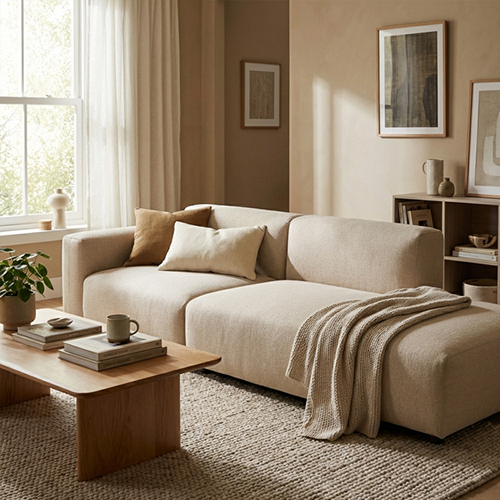
I've learned that the perceived value of an object is often dictated less by the object itself and more by the space it occupies. Place a simple, well-made sofa in a poorly lit, cluttered environment, and it becomes an unremarkable commodity. Place that same sofa in a thoughtfully designed space, with light that catches its texture and a composition that speaks to a certain way of life, and its price can multiply three- or fourfold. The product hasn't changed, but its story has.
This is the central challenge in the world of furniture. Unlike clothing or jewelry, where the focus can be tightly cropped on the item and a model, a piece of furniture must command a space. It must coexist with dozens of other objects, from the rug beneath it to the lamp beside it and the art on the wall behind it. Its photograph isn't just a record of its existence; it's a proposal for a lifestyle.
For years, this has made high-quality product imagery the exclusive domain of brands with deep pockets. The logistics are formidable: shipping heavy prototypes to a studio, hiring stylists and photographers, building sets, and managing complex lighting. The hidden costs for a single product can easily run into the thousands, or even tens of thousands, of dollars.
When generative AI began to reshape the creative landscape, the promise of a shortcut was tantalizing. Yet the initial results for furniture were consistently disappointing. The problem wasn't that general-purpose AI tools were "bad," but that they were fundamentally unequipped for the unique physics and poetics of a furnished room. They struggled with the subtleties of scale and proportion, the interplay of light and shadow on different materials, and the complex rules of interior design. The output often had a synthetic, "plastic" feel, or was filled with the strange, hallucinatory artifacts common to early AI generation.
It became clear that what the furniture industry needed wasn't just a better image generator. It needed a solution built on a deep understanding of its specific operational realities.
From Photographer to Product Strategist
The first principle we had to internalize is that our role is not that of a simple photographer. A photographer is given a subject and told to capture it. Our system, however, needed to function as a product planner, a visual editor, and a merchandising strategist all at once.
When a furniture company launches a new product, it doesn't just need one beautiful picture. It needs a complete visual package that guides a potential customer through a specific psychological journey. This journey typically has three acts:
-
"What is this?" — The White Background Shot. The first encounter must be one of clarity. The customer needs to see the product isolated from distraction, often from multiple angles—front, side, and a 45-degree view. These "studio shots" are essential for e-commerce platforms. Their purpose is to communicate the product's fundamental form, proportions, and scale without ambiguity. For these images, accuracy is paramount.
-
"I want this." — The Lifestyle Scene. This is where the product's story is told. By placing it in an aspirational interior, we move from documenting an object to selling a feeling. The quality of the interior design, the sophistication of the lighting, and the overall aesthetic of the scene determine the product's perceived value and the type of customer it will attract. This is the most complex part of the equation, as it involves not just rendering a sofa, but designing an entire virtual room around it. This is where a generic product becomes part of a desirable life.
-
"This is reliable." — The Detail Shot. For a considered purchase like furniture, trust is critical. Customers shopping online can't touch the fabric or inspect the joinery. Detail shots serve this purpose. They need to crisply render the texture of the leather, the weave of the fabric, the finish on a metal leg, or the grain of the wood. These images must convey quality and craftsmanship, reassuring the customer that the product is as good up close as it is from a distance.
A traditional photoshoot struggles to deliver this complete package efficiently. Our goal with White Studio was to systematize this process. We designed a workflow where a single, simple photo taken on a phone could be transformed into a comprehensive go-to-market package of up to 16 images, covering all three acts of this commercial narrative. This wasn't a purely technical challenge; it was an operational one. It required embedding decades of industry experience into the logic of the tool itself.
Bridging the Gap Between Code and Craft
A common question I receive is about our underlying technology. People are often curious about the specifics of our AI models, assuming we've developed some uniquely powerful architecture. The truth is simpler. We did not build a secret model; we use capable AI image tools like many others do. Our advantage comes from what surrounds the model: a decade of industry experience, a workflow built specifically for furniture, and a critical human touch.
The "plastic" and distorted look of many AI-generated images stems from a lack of real-world grounding. An AI trained on a vast, undifferentiated dataset of "interiors" doesn't understand that a certain type of wood has a specific grain, that light reflects differently off velvet than it does off linen, or that the legs of a chair must all touch the floor in a physically plausible way.
Our approach has been to infuse our system with specialized knowledge. We've spent over a decade in the furniture industry, learning how to light a scene to emphasize texture, how to stage a room to tell a story, and how to frame a shot to communicate both elegance and function. This knowledge—all the subtle decisions a professional photographer and stylist make on set—has been systematically built into how we brief, prompt, and select from the AI tools we use.
But no AI tool is infallible. It can still produce "hallucinations" or subtle errors in scale, color, or form. This is why we never aimed for a fully automated process. We built a human-in-the-loop system.
Every image package we generate is reviewed by a quality control team. These are not generic content moderators; they are designers and photographers with years of experience in the furniture industry. Their trained eyes can spot when the scale of a chair feels slightly off relative to a table, when the color of a fabric isn't a true representation of the original, or when a shadow falls in an unnatural way. They use a combination of visual inspection and digital tools to ensure every image meets a high standard of realism and aesthetic integrity. It's this fusion of AI's speed with the discerning eye of a human expert that keeps our results out of the uncanny valley where most generic tools reside.
The Economics of Aesthetics
This refined process allows for a radical restructuring of the economics of product imagery. A traditional photoshoot for a single product, as mentioned, can cost thousands. We can deliver a full, professional image package for a fraction of that—our Standard 16-Image Pack is $99, with a lighter 4-image option at $39 for trying us out or launching new SKUs. The turnaround is just as dramatic: what once took weeks or months of logistical planning can now be accomplished within 24 hours.
This isn't just an incremental improvement; it's a paradigm shift that democratizes quality. Suddenly, small- and medium-sized manufacturers, independent designers, and cross-border e-commerce sellers have access to the same high-caliber visual assets as the largest brands in the industry. They can compete on a level playing field, where the quality of their product's presentation is no longer limited by their marketing budget.
A case from a Danish client illustrates this perfectly. They were preparing to launch a new multifunctional bed with four design variations and 12 different fabric options. This created a matrix of 48 unique SKUs. To photograph all of them traditionally in Europe would have required producing 48 physical prototypes, shipping them to a studio, and coordinating a massive, multi-day shoot. The estimated cost was several thousand euros, and the timeline was at least 60 days from start to finish.
Instead, they sent us about ten simple photos of their existing prototypes, taken with a smartphone. Within 72 hours, we delivered a complete set of high-resolution, commercially ready images for all 48 variations, each shown from multiple angles and in beautifully styled environments. The difference in efficiency and cost was staggering.
A New Model for Manufacturing
Perhaps the most profound impact of this capability extends beyond marketing and into the very heart of manufacturing and product development. By decoupling high-fidelity imagery from physical production, we enable a model of "demand-driven production."
Historically, a brand had to commit significant capital to manufacture inventory before it could even begin to market a new product. If a particular color or style didn't sell, they were left with costly, unsold goods.
Now, that risk can be almost entirely eliminated. With a tool like White Studio, a company can generate photorealistic images for an entire collection—including colors and variations that do not yet exist—and test them directly with their audience. They can run A/B tests on their website, gather feedback on social media, or even launch pre-order campaigns for different options. The market's response, not a product manager's intuition, dictates what gets produced.
This allows companies to be more nimble, more responsive, and far more capital-efficient. It accelerates the go-to-market cycle and reduces the risk associated with innovation. The conversation shifts from "What can we afford to make?" to "What does our customer truly want?"
Ultimately, the goal was never just to build an AI that could make pretty pictures of furniture. It was to solve a set of deep, interconnected business problems for an industry I know well. The true measure of our success is not in the sophistication of our algorithms, but in the utility we provide to our users—the small factory, the independent designer, the ambitious e-commerce entrepreneur. We give them the ability to tell their product's story beautifully, efficiently, and effectively, allowing their craftsmanship to shine on a global stage. The technology is just the means to that end.
This perspective is what truly differentiates us. While much of the conversation around generative AI focuses on replacing human creativity, our aim has always been to augment it. We are not creating a substitute for the designer's vision or the photographer's eye. Instead, we are building a specialized instrument that removes a tedious and prohibitive bottleneck. It is a tool of liberation, designed to serve the practical needs of creators in a field that has long deserved better.
You can see the results of this process at whitestudio.art.