 white studio
AI Furniture Photography vs Traditional Photoshoot: Which to Use When
By Vee S. · Founder, White Studio
You are staring at a studio estimate and a launch date that will not move. The sofa is already in the warehouse. Marketplace deadlines are fixed. The question is not whether photography matters—it does—but which production model gets accurate images live without burning the quarter.
AI furniture photography usually wins on speed, logistics, and catalog coverage; traditional photoshoots still win for flagship campaign work and situations that need total on-set control. The useful question is not “AI or studio forever?” but which SKUs need a physical shoot versus expansion from existing photos. Image-to-image services with human art direction—like White Studio’s 24-hour packs—sit between DIY generators and full studio production.
This guide is a practical comparison for furniture ecommerce teams: what traditional shoots actually cost in ops, what AI is good at, where DIY tools fail the comparison, and how hybrid workflows allocate budget by tier. For category basics, start with what is AI furniture photography.
The real cost of a furniture photoshoot isn’t only the day rate
When founders compare AI furniture photography vs traditional photography, they often look at a photographer quote and stop. That undercounts the job. For sofas, beds, dining sets, and cabinets, the expensive parts are often the ones that never appear as a clean line item on an invoice.
Shipping and handling. Moving a sectional or king bed means trucks, insurance, crew time, and damage risk. Overseas samples add freight and customs delays.
Space and scheduling. Furniture needs floor area and lifestyle room. Studio calendars fill weeks ahead; a missed fabric delivery slips the day.
Styling, props, and reshoots. Lifestyle sets multiply prep; every scene change resets the clock. A wrong finish or failed marketplace crop means repeating the logistics chain.
Opportunity cost. While assets wait for retouching, listings stay thin and ads stay paused. For high-SKU catalogs, delay often hurts more than the day rate.
The fully loaded cost is logistics-heavy, not just creative-heavy. If you cannot move fifty frames this quarter, you are comparing production systems—not picking a prettier filter.
What traditional photography still does best
Traditional furniture photography remains the reference for work that depends on physical control of light, props, and performance.
Hero campaigns and brand films. Editorial sets, print covers, trade-show walls, and signature paid-social heroes still benefit from on-set craft.
Tactile luxury close-ups. Lacquer, deep bouclé, mirrored fronts, and complex glass often need lighting control that skilled photographers still handle best in-camera.
Unusual construction and compliance. Atypical silhouettes, “photograph the exact unit” contracts, or wholesale proof requirements still belong on a physical set.
Video, 360°, and AR from the real object. Capture motion or spatial assets from the physical piece first; expand still coverage with AI around approved masters.
Use traditional production where craft moves top-of-funnel revenue. Do not force every long-tail fabric through the same crew day.
What AI furniture photography is actually good at
Production-minded AI furniture photography is not “type a prompt and invent a sofa.” At its best, it is image-to-image: your real product photos are the structural anchor; AI rebuilds lighting, backgrounds, and room context around that SKU; designers review for fidelity before you publish.
That model fits day-to-day ecommerce needs:
Catalog coverage. White-background heroes, angles, and marketplace-friendly crops at the volume Amazon, Wayfair, Shopify, and wholesale portals expect.
Lifestyle variants without rebuilding rooms. Clear source photos let you explore room moods without another prop day.
Faster launches from existing photos. Warehouse, showroom, or factory phone photos—if the silhouette is clear—can become listing packs in about a day.
Variant and long-tail expansion. Same frame, twelve fabrics: curated AI with human QA scales cleaner than twelve physical samples.
Operational velocity. Seasonal drops, marketplace expansions, and lifestyle A/B tests favor hours-scale turnaround over weeks-scale scheduling.
If you need accurate galleries for many SKUs before a promo window, AI packs usually win. If one campaign must feel unmistakably yours on set, keep the studio.
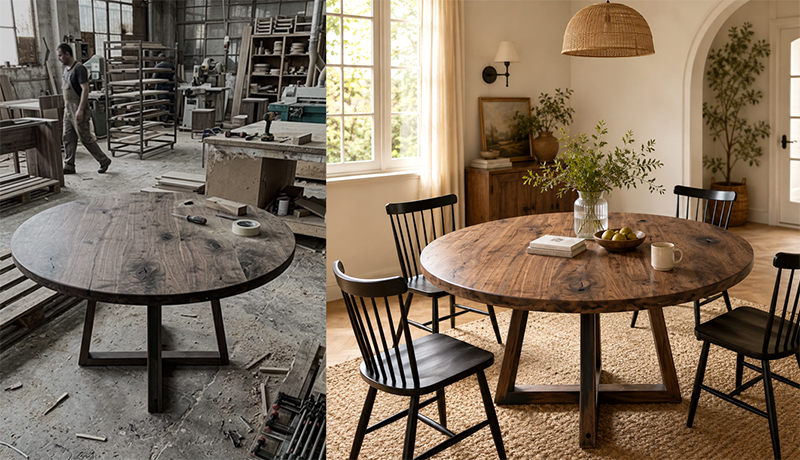
Customer source photo (left) and the delivered still (right), from a real White Studio order. No studio, set, or shipping was involved.
Side-by-side: speed, logistics, consistency, control
Qualitative comparison—no fake day-rate benchmarks. Use this as an allocation table, not a scoreboard.
| Dimension | Traditional photoshoot | Curated AI (image-to-image + human review) | DIY generators / cutout apps |
|---|---|---|---|
| Speed | Weeks common (schedule → shoot → retouch) | 24 hours for stills packs | Minutes to hours—but iteration and QA often eat the win |
| Logistics | Ship/move heavy pieces; studio space; props | Phone or basic photos in place; no product freight | Same light input needs; you own all QA |
| Consistency across catalog | Strong with a repeat studio partner | Strong once templates + art direction lock | Weak—each prompt/session drifts |
| Product fidelity | Exact unit in frame | High when source photos are clear and humans review | Risk of hallucination / product drift |
| Creative control on set | Highest | Direction via style + pack type, not live lighting | Prompt-level only |
| Best SKU fit | Flagship heroes, films, complex sets | Catalog, lifestyle packs, variants, launches | Mood boards, experiments, one-offs |
| Public pack pricing (WS) | Custom studio quotes | Lite (4 images) · Standard (16 images) | Tool subscriptions + your time |
Read the table as tiers, not ideology. Traditional wins control. Curated AI wins coverage and velocity. DIY wins exploration—and loses when “almost right” images go live on a PDP.
Hybrid workflows brands actually use
Sophisticated teams rarely pick a single forever answer to AI furniture photography vs traditional photography. They allocate by tier:
| Tier | Typical use | Method |
|---|---|---|
| Hero | Homepage, paid social, press, brand film | Traditional or premium on-set / CGI |
| Catalog | Marketplace listings, category pages, wholesale | Curated AI packs with human QA |
| Long tail | Variants, regional SKUs, replacements | AI from phone photos of existing masters |
Common patterns in practice:
- Shoot once for masters; expand with AI. Capture the frame (or a hero finish) traditionally; roll fabrics and lifestyle with image-to-image packs.
- AI for launch; traditional for winners. Ship marketplace galleries fast; reshoot on set only for SKUs that prove demand.
- Factory phone photos → listings. Manufacturers skip flying every sample; curated packs bridge production photos to retailer deadlines.
- Keep DIY in the sandbox. Mood comps stay in prompt tools; live listings use product-preserving pipelines.
Match method to margin and velocity. For the “do we even need a shoot?” frame, see Can you skip the photoshoot entirely? below.
Price one mid-tier SKU both ways—studio logistics versus a curated pack—then test quality with Lite (four designer-curated images from your real photos). Roll winners to a full Standard set.
Where DIY AI fails the comparison
Generic text-to-image tools answer: “What might a modern gray sofa look like in a coastal living room?” Catalogs need: “What does this sofa look like in a coastal living room?”
That gap shows up as:
Product drift. Arms thicken, legs shorten, cushion counts change, wood tones warm into something you do not sell.
Inconsistent catalogs. Twelve prompt sessions can look like twelve brands—even when titles are tidy.
Hidden labor. Someone still regenerates, fixes warped legs, and debates fabric match. The “free” tool becomes an unpaid studio.
No listing system. Cutout apps solve backgrounds; they do not deliver a coherent white + lifestyle + detail pack.
White Studio’s differentiator is deliberate: real-product image-to-image + designer curation, not another Midjourney wrapper. Upload 1–3 photos of the piece you sell; models rebuild scenes around that product; humans catch fidelity failures before download. You are comparing studio logistics vs curated packs—not studio vs random generative art.
For a landscape of DIY vs curated approaches (without fake “#1 tool” rankings), see best AI furniture photography tools.
White Studio as the middle path
White Studio is built as a furniture-first service between full traditional crews and DIY generators:
- Capture 1–3 photos of the real product (phone is fine if the piece is fully visible and color is roughly true).
- Upload and choose direction — category and lifestyle preference; you are not writing paragraph prompts.
- AI generation + designer curation — white-background, lifestyle, and detail views reviewed for commercial readiness.
- Download in 24 hours — packs ready for listings, ads, and marketplace uploads.
| Pack | What you get | Best for |
|---|---|---|
| Lite | 4 images (1 white-background, 2 lifestyle, 1 detail) | Quality test on one SKU; unblocking a thin listing |
| Standard | 16 images (4 white-background, 6 lifestyle, 6 detail) | Full listing launch across channels |
Shopify merchants order from the site: pricing · order. Service overview: AI furniture photography.
What you are buying is a constrained pipeline: real product in → listing pack out, with art direction in the middle. That is the middle path the hybrid table assumes.
Can you skip the photoshoot entirely?
For most catalog work, yes—if you keep the product truth. Teams that skip a studio booking usually take one of three paths:
| Path | Works when | Breaks when |
|---|---|---|
| DIY shoot + manual editing | You have design talent and time | You need consistent lifestyle scenes across dozens of SKUs |
| Self-serve AI staging tools | You are exploring moods and ideas | Text-to-image drifts the product: wrong arm height, invented wood tone, melted legs |
| Curated image-to-image packs | You need listing-ready white, lifestyle, and detail images of the real piece | You need on-set campaign craft or contracts that require an "actual photograph" |
Source photos do not need a studio, but they do need to be truthful: even light, the whole piece in frame, true color with no filters, and a front view plus one or two supporting angles. Warehouse bays and showroom corners are fine. Outdoor sets, multi-fabric lines, and tricky materials need extra angles and finish close-ups; heavy glass or mirror pieces may still justify a traditional hero shot.
FAQ
Does AI furniture photography replace traditional studio shoots?
For most catalog, marketplace, and variant work—often yes as the primary production method. For flagship campaigns, brand films, complex luxury sets, and contractual photographic proof of the exact unit—usually no. Most brands run both: studio for heroes, curated AI for coverage.
Will AI images increase returns if color or scale is off?
Returns risk comes from misrepresentation, regardless of capture method. Image-to-image workflows plus human review reduce drift versus prompt-invented products. Still: use clear source photos, check color against physical samples when stakes are high, and treat extreme materials (deep pile, heavy reflection, glass) with extra QA—or keep those SKUs on a traditional pass.
When should I not use AI for furniture photos?
Skip AI-first production when stakeholders require on-set photographic proof, when the piece’s geometry cannot be inferred from available photos, when the creative brief is a bespoke editorial narrative, or when you need physical capture for video/360/AR from the object itself. Use AI for volume around approved masters instead.
How does the cost compare?
Traditional cost is logistics-heavy: transport, space, styling, schedule risk, and reshoots. Curated AI packs shift cost to a known per-SKU pack price—White Studio Lite and Standard—with 24-hour image delivery and no product freight. Compare fully loaded ops for your SKU count and calendar, not a single day rate.
Is White Studio the same as Midjourney or ChatGPT image tools?
No. Those tools excel at inventing scenes from text. Catalog work needs image-to-image preservation of your SKU plus designer review. If a workflow starts from a prompt instead of your product photo, treat the output as concept art until proven otherwise.
Where should I start if I only want to test quality?
Challenge yourself to price one mid-tier SKU both ways. Then order Lite on that SKU. If fidelity and style match, expand to Standard for a full white + lifestyle + detail set, and start an order for the next wave of winners.
Next step: allocate by SKU, not by ideology
AI vs traditional is an allocation problem. Traditional owns flagship control. Curated image-to-image packs own catalog speed and logistics relief. DIY owns exploration—and should stay out of live listings until a human verifies the product is still the product.
When you are ready for a complete gallery from photos you already have, choose the Standard pack and upload 1–3 phone photos. Prefer a low-risk first look? Start with Lite, then scale what works.
Explore what is White Studio, AI furniture photography, pricing, and order—or the guide what is AI furniture photography and best AI furniture photography tools.